THE KING OF STEAM · FOR YOUR PROGRAM
Teach AI-assisted design through the work of making.
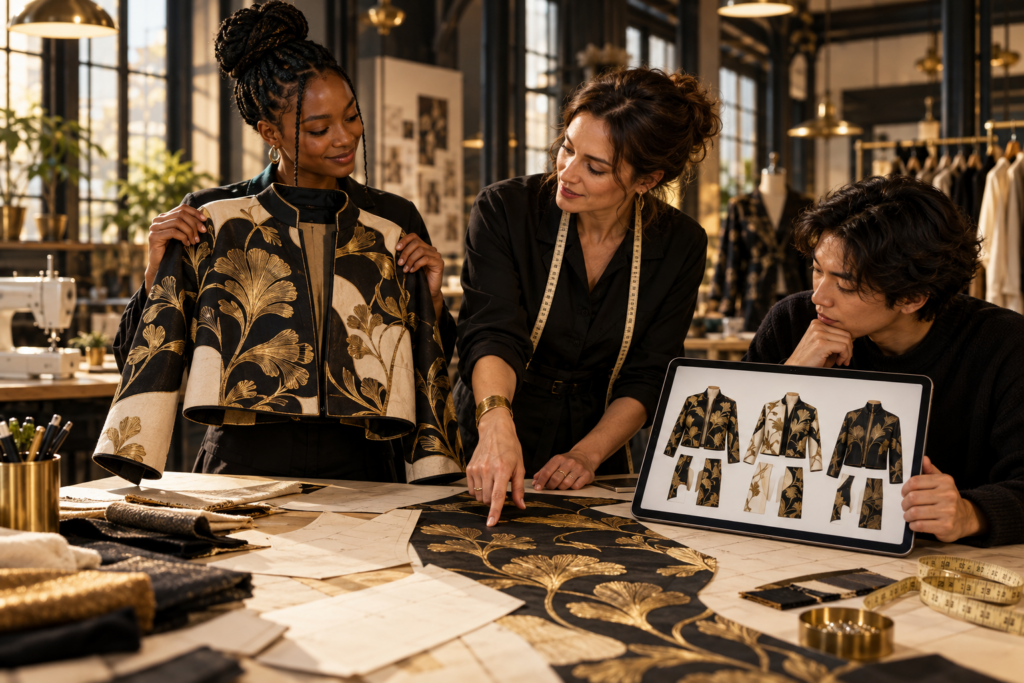
Give learners a practical way to move from an idea to a garment, a presentation and a connected experience. KOS brings garment development and creative practice into a program built around your learners and teaching goals.
Learn the process. Build an offer. Serve a customer.
A learner begins with a person or organization to serve. They develop a brief, explore ideas with AI, evaluate the results and make design decisions. Production planning turns that idea into questions about materials, costs, quality and delivery.
These skills can support employment, freelance work or entrepreneurship. A customer brief can be real or simulated, with that distinction made clear. Students do not need to start a company or become public models to participate.
Three levels, with a practical application
Level 1: Design & Manufacture. Work with garment patterns and follow printing, transfer, cutting, sewing and quality checks. A manufactured garment is included only under the agreed course-package terms. Explore Level 1
Level 2: The Walking Billboard. Develop a presentation and wearable campaign around an audience and purpose. Examine field observations critically, including the difference between attention and a commercial result. Explore Level 2
Level 3: Connected Garments. Develop a QR destination, product-information record and responsible measurement plan. Study emerging passport requirements as readiness work. Explore Level 3
A proposed capstone: a useful offer, explained clearly
The learner presents a customer need, a design brief, their AI-assisted process and human decisions, a production or delivery plan, a cost outline and a finished presentation. The partner and KOS agree the assessment and any manufactured output before delivery.
AI as a working skill
Teach learners to provide context, question outputs, revise deliberately and explain their own contribution. Discuss permission to use source material, attribution, privacy and ownership before a project is shared or sold. AI supports the work; the learner remains responsible for the choices.
Built to fit your existing program
The proposed institutional model prepares and assesses a designated partner instructor to lead regular classes, with scheduled contributions from Chuck and Vilma. The agreement defines curriculum use, instructor preparation, learner capacity, support, dates and fees. White-label or adapted delivery requires agreed terms.
Your organization supplies its teaching context and learner support. Together we define supervision, equipment, accessibility, consent for photography, assessment and any factory visit. Manufacturing, travel, shipping and digital hosting are identified separately where relevant.
Begin with one defined learning project
Choose a learner group and a useful outcome. Review a design-to-production demonstration, then agree the scope of a paid workshop or instructor-preparation engagement. A factory experience can be considered when the facility, dates, safety arrangements and deliverables are confirmed.
Public enrollment is not open. Institutional delivery and pricing are arranged by agreement.
Teach learners to evaluate the opportunity.
Alongside design skills, help learners examine a runway or client proposal: what is promised, what evidence supports it, what rights are involved, and who will deliver? The proposed capstone can include a production-cost outline and a reasoned decision about an opportunity.
Give participants something useful after the show.
Before you pay for a fashion show: use the checklist
Organizers can discuss adding a practical KOS workshop to an event. We agree the learner group, teaching time, instructor responsibilities and work participants will complete. The aim is to help designers explain their offer and understand what must happen before accepting an order.
Discuss an education component
Sample exercise: a connected garment for a community exhibition.
Fictional brief: a community arts organization needs a garment that introduces its annual exhibition and opens an accessible event-information page. Develop a proposal the organization could evaluate. Presenting on a mannequin or flat layout is an option; wearing the garment is not required.
The learner’s work
1. Define the audience, message and next action.
2. Explore ideas with AI and record accepted, rejected and revised outputs.
3. Place artwork on a garment template and identify seam, stretch and QR tests.
4. Separate confirmed costs, estimates and supplier questions.
5. Build a demonstration information page and test its QR link.
6. Present the proposal, permissions, production dependencies and follow-up plan.
What is assessed
The learner submits a customer brief, annotated garment concept, AI-and-human decision log, cost outline, demonstration page and production-question list. Assessment considers clear communication, creative judgment and accurate use of evidence. A screen scan does not establish reliability on fabric.
This is a sample exercise for partner review. Teaching time, assessment and any manufactured sample are agreed with the institution.